The night had been coming for the past two hours. It had come and slowed itself and twisted itself like it was snarled and shaken—-shake it out, lass. It was dark, then. And it looted. He had told her, earlier, he would go to death. After, he said. Now he laid, his hands together. The night takes things from her body. She is an alien. She wears tight space suits and walks in long dramatic steps and she has antennas and she does experiments to him and makes him want to walk to death. Or ride. His hands are tempted and sweated and the small parts of her back—-those parts are not human. She could not be a human. She does experiments with him and looks at him like the other girls don’t look at him, not like that—-not then.
He begins to think that he has missed the train and he would have to walk or sleep in his uncle’s basement and his uncle is on a mean drinking binge. His uncle is on a mean twelve year drinking binge: kept and urged and strained by the ins and outs of an unjust saddened heart—-he is in the pits of a tempered and tame existence. His uncle once put his hand through a windshield. His uncle was angry and round in the face—-he gets round in the face when he is drunk and impaled into the past deviled women (she stilled, in white). It is then that his uncle will say howler things: it is then, sometimes, that his uncle is a monkey.
‘I have missed the train. I will have to walk.’ He thinks and he is sure that he will not go to his uncle’s basement and she is in her suit now, again in her suit, zipped and patient. She has her chin on her fingers on his chest and she looks at him and it is like she does not breathe. She is an alien, he thinks again and now he is sure of it, even though it is darkened and hollowed and she is unseen in part. ‘I must get to death.’ He thinks again, and taunts the alien.
“You will take me?” He asks her, all of a sudden, but she does not twitch. Aliens do not twitch when they are shocked and taken by surprise. Aliens look back and say things that make the others think that they are alone, here and there.
“Yes.” She says. “I will take you to the train and if we have missed the train, I will walk with you there and I will not stop you.”
“Oh.” He says and decides that now he must go. He is caved and soiled and emptied, then. He is caved and the back and forth of the tantrums return to rid him of the blanket nested pills: he will not burst, yet. He is in shakes and he has held water—she will not see the bleeded and haunted street urchin turned in on itself: bitten, pierced and logged by its own poison.
That is for me.
[s]
2.14.2006

2.13.2006
Let’s consider the stars:
Above the Earth, where no one you know has ever been , there are enormous stretches of empty space. You cannot imagine it; it is like saying: Picture ten people, and now picture ten thousand more. It is like saying: Every time you move your hand six inches you pass through billions and billions of dimensions so tiny they curl up in invisible pockets between length, width, and height. Unthinkable: like God or death, like spending a lifetime to calculate the actual number of stars; but true,
or so we hear from certain scientists, whom we are inclined to believe, or not, it’s a question of faith so there are no answers. In this way belief is like the stars themselves, how they shine a light from great distances and die long before we notice. Take me, for example. I am so hungry for love that I left you buried by second-person singular in the first sentence, where no one would realize that it was you under there: your body, your small hands, your hair. I am so hungry for love I had to pretend I was full with my talk of numbers, and unthinkable things. Really there is no such thing as empty space, not in this Universe; and this is not about God or earth or two-dimensional loops of string that vibrate it all into being. You are not like a star-death; you are like a light that went on long before I noticed it. Forgive me; I was so busy reading my books I didn’t wonder why I could see them at all.
-amr-a
Untitled 2
Who am I? The more we talk the less I know about
the city lights,
and the starry sky,
and the moon pulling our blood
I have already forgotten my body, which has
a heart
and a web of veins
and bones, too,
of my parents' parents, no matter how
they shaped me,
no matter what they did
or did not finally say.
kissed me I could feel her pull hard, sucking the air
from my lungs to hers,
so that when she opened her lips
it would return
I know that we die, and I don't know what comes after:
if we turn into dirt;
if we turn into light;
or if the moon, rising, will keep its promise,
slowly
-amr--
the city lights,
and the starry sky,
and the moon pulling our blood
towards heaven.Must I only know myself through others? If so then
I have already forgotten my body, which has
a heart
and a web of veins
and bones, too,
but is not those things, no,just as I am not my hands or my parents or the hands
of my parents' parents, no matter how
they shaped me,
no matter what they did
or did not finally say.
Neither am I stardust,though I knew a woman who said I am, and whenever she
kissed me I could feel her pull hard, sucking the air
from my lungs to hers,
so that when she opened her lips
it would return
to the stars.I don't believe that I am air, or beautiful, or necessary.
I know that we die, and I don't know what comes after:
if we turn into dirt;
if we turn into light;
or if the moon, rising, will keep its promise,
and pull us towards heaven
slowly
-amr--
Untitled
Plans are what we make when nothing is happening--
take yesterday, for instance:
the snowfall, the rose bush, neither of us knowing
what would come next. Is the saying so important?
Or is it better to find the plan beneath the day,
like a stone in the snow--
crouch down, roll up our sleeves,
and dig in?
Holes are what we make when nothing
seems to be happening; though seeing is not seem,
and certainly something is happening--
(did you feel it?) it is happening
right now
-amr--
2.12.2006
henry had a heart of god he worn it round his mouth
no matter; the word had never gotten out round most folks most anyways,
and a lot of use it’d did fallen on deaf ears,
is what me, and some people said.
in the end, is the whole world waiting to eat us up
and what comes next, which is nothing to do with me
or you or anybody you’ve ever shook hands with,
you can be sure of that:
if you really need something to wrap your mouth around
I’d rather keep the answers till we’re on god’s time,
not mine, henry (talking like a soldier knows hes gonna die)
not mine
-amr-™
2.08.2006
ocean springs
He is thin and he has thinned bones and he straddles a gray horse that stands in the tall grass and moves back and forth and whimpers. The mud marches, he thinks. Branches break in the march and they sound like chants. But they are not supposed to be in unison. The homes undress and wilt. They are spade. There are no children coming here. These are deserted monarchs. The mud huts want to die. God wants the mud huts to die.
The woman with the green and white headdress shouts something about god and the dirt and the mud and the hill. The villagers nod. It is god, they think, and they begin to kneel and pray and put their hands together like little churches.
The mudslides had been coming since the rain had started and the rain had been coming for the most part of three weeks. The men with guns and boots sit in tents and watch the slides and do not speak to the men and women in the town. They say the town is going to go into the mud river and not return. They do not believe the woman with the green and white headdress. “She did not talk to god.” They say. “Even he cannot protect this town from this rain.”
The colonel says it is an on off switch and then spends most of the first week losing his property in card games. They are cheating, he says. But he does not shake his head. The mudslides creep and only move about an inch, maybe two, maybe three. Generally, they only move a few inches an hour. It is possible to get out of the way. The slides are not that fast. There are families in the basement of the valley that began to take apart their homes. We will rebuild them on the other side of the river, they say. One of them has a birthmark that looks like a black eye. He does not like the other men in the village. “Their houses can go away,” He says. “God is telling us to move.”
The man on the horse does not see god because he stares at his own house drown. His house is close—closest to the mudslide. He is on a horse and he cannot stop the mud. There is too much mud and it is raining and the water looks like it is in a bathtub. The wind is not too much but the hill will begin to drag the water down into the center of the village and the water will begin to look like a great river. He sits on his horse and watches his home split into two. The soldiers say some women can fall out of their dresses when they are not careful. He has not seen it. But it looks like his house. She falls out of herself and looks awkward and exposed and he is embarrassed.
It was not a good place to build a village, he thinks. The men at the basement of the valley will see the river soon. They will not get their homes out in time. They will die with the sticks in their hands. The sticks are their walls. The soldiers do not smile. They play cards and say the woman is wrong. God walks along the edge of the mountain. It does not rain on god. He rips trees out of the ground and watches the loose dirt slip. Silly woman with a green and white head dress, he thinks.
The soldiers are right. The village should have cursed the rain.
[s]
2.04.2006
let will, child prostitute
I.
She wills herself to suicide herself. She mourns and preps and wears black and makes her face look bloated and drowned: like it has swallowed too much water, too much urine, too much waste. I am a waster, she thinks, and it seems like it is mild and cooked water in her blood—oh sweet, oh sweet: I am alive again.
She smiles and ssh-es herself and stares at her rounded eyes in the oval mirror. Once, earlier, when she is twelve—on her first sauntered and dipped Tequilla binge—she wills herself to the less difficult and more simple return: to suicide her mother.
“She is a prostitute,” She says and she wears knee-highs and she is comforted in the twilight hold of the evening pantry. The summer has turned already. The heat that has made the men and women look stale and spared—opened by lynched drawls and So-Co wisdom. The heat has gone and twisted itself into the death marches, the staunch steps of a leafless and ironed flat.
“She is a prostitute,” She says, again, and now she is on the porch. Once, she is twelve. And then it is truly the orange and yellow and red and the crisp that is—that must be—the way it is to death if it is the way each year the world is to death. They hear, perhaps both times. They hear it in the living rooms, close to the swinging doors of the pantry, the screen door of the porch. They squat on the Italian couches and the rugged, offseason wallpaper. The inned men and the outed women are silent together.
But in the riffs of the next day, the waits are un-done. The open and deadfaced tongues run and come out. Soon, the town is in circles on her lawn. They hold fire on their fingers and they tell her: “You Whore! You!”
She was a prostitute, she thinks now, and stands bare. Her eyed opened tunic shows this now seventeen skin. Her windows are opened and see. The property is widowed into her name, or widowed-heired, or perhaps just left for her once. She stands, a smooth skin silk skinned, and wears the week in thought: my waked, alas.
The pauses and the wait are, generally, unbearable. Until she will actually suicide herself. Until she will walk to the bushes behind the school auditorium and urinate and turn herself bleeded.
The after party, for the woman, her mother, her suicided prostitute whore of an uncouth nature, was more or less adequate for the occasion. She even felt herself enjoying the company of the tonic downed men, the limp dressed men. They were often on site in heaved ho.
II.
He wires himself into the pit of women. Perhaps protests at his own childlike death—no, the childlike death of his wife, after his mother. After these women, cut and bleeded on tiles and ice wells, swamped into the terror of web feet and prophetics, heretics: wizards. While he, alone and barred into a soiled solitude, is the hand holder, the hand soldier, of the ministers.
He is the leading authority on the nature of women and their tragic yet oddly familiar interest in death walks, suicides, passionless and egoless existences. Yet surprised and seeming to hawk their eyes into the resourceless, the women are benevolently disposed to dispose of themselves in horrific and necessary acts of heroism and stupidity. It is only fickle transgression, capped in the end by meager and pointless drama—boiling points. It is best to stand clear.
[s]
1.30.2006
Boundaries, Part III
K. asks me to remind her where her boundaries are. Then she adds, “You work too hard for love,” and hangs up the phone.
How true! I first learned of boundaries while working at a health clinic for the homeless. Every day they would gather at the door before morning, while inside we set up the ropes that organized their need into orderly rows and straight lines. One November I met a girl with an abscessed tooth and we ended up sleeping together for three weeks; for almost twenty-one days I sheltered her in the white sheets of my bed while the bungalow shuddered under a rainstorm that turned the lawn to mud and elsewhere washed entire towns away. On the twenty-first morning she was gone. I later heard from the line that she had gone back to the subway and had a baby and never wanted anything from the day-lit world again.
You learn to live without love, if you work at it hard enough. For one thing the bed is all yours and the stars never sting and even a particularly good song will pass right through you, it gets that simple. Years went by before I found myself working as a re-educator for sexually criminal youth. “You can learn to live without love, if you work hard enough,” I taught them, and they all took notes. They had to; their P.O.s were always in the back of classroom, tapping their billy-clubs as a reminder of what waited for those who failed my class -- which was prison, of course, and secretly I think each P.O. believed that anal or oral penetration behind bars was the only effective treatment for these youth (who were deviants, let there be no doubt; but also often illiterate and very few passed, despite my best intentions). “What is the offense cycle?” I would ask them, and then drew it on the board like this:
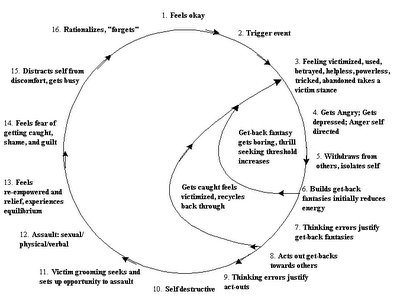
Once every few months, a particularly aggressive youth might ignore the P.O. tapping behind him and ask how knowing the offense cycle did him any good at all. My supervisor warned me about this kind of youth, and gave me the correct response, which I would dutifully relay to the class. “Learning the offense cycle is important,” I began, “for four reasons: 1) It makes the youth’s behavior predictable by bringing it into full consciousness; 2) It proves the youth can be extremely self-observant; 3) It enable the youth to experience vulnerability as a positive and empowering experience; and 4) It provides an experience of nonsexual intimacy and personal self-control, which ultimately helps the youth to abandon the secrecy of his self,” this latter point never failing to get grins and nods from the officers in the back.
If I don’t regret my choices, then I must not regret the life I made of them: my re-education days are long gone and somehow the months have slipped into comfortable repetition, like white sheets or a sleeping body breathing in time to secret rhythms. Most nights I remember my dreams, but come morning I am too busy to write them down: I have subways to catch, bills to pay, friends to phone and meals to eat. There is always work to be done. “Remind me,” K. says, “because sometimes I forget where I end and others begin.”
“It is no problem,” I reply. “First figure out what you most need -- then take a rope and split it in half. Now all you have to do is choose which side you will spent your whole life wanting, and which side you will just call home.”
-amr-
How true! I first learned of boundaries while working at a health clinic for the homeless. Every day they would gather at the door before morning, while inside we set up the ropes that organized their need into orderly rows and straight lines. One November I met a girl with an abscessed tooth and we ended up sleeping together for three weeks; for almost twenty-one days I sheltered her in the white sheets of my bed while the bungalow shuddered under a rainstorm that turned the lawn to mud and elsewhere washed entire towns away. On the twenty-first morning she was gone. I later heard from the line that she had gone back to the subway and had a baby and never wanted anything from the day-lit world again.
You learn to live without love, if you work at it hard enough. For one thing the bed is all yours and the stars never sting and even a particularly good song will pass right through you, it gets that simple. Years went by before I found myself working as a re-educator for sexually criminal youth. “You can learn to live without love, if you work hard enough,” I taught them, and they all took notes. They had to; their P.O.s were always in the back of classroom, tapping their billy-clubs as a reminder of what waited for those who failed my class -- which was prison, of course, and secretly I think each P.O. believed that anal or oral penetration behind bars was the only effective treatment for these youth (who were deviants, let there be no doubt; but also often illiterate and very few passed, despite my best intentions). “What is the offense cycle?” I would ask them, and then drew it on the board like this:

Once every few months, a particularly aggressive youth might ignore the P.O. tapping behind him and ask how knowing the offense cycle did him any good at all. My supervisor warned me about this kind of youth, and gave me the correct response, which I would dutifully relay to the class. “Learning the offense cycle is important,” I began, “for four reasons: 1) It makes the youth’s behavior predictable by bringing it into full consciousness; 2) It proves the youth can be extremely self-observant; 3) It enable the youth to experience vulnerability as a positive and empowering experience; and 4) It provides an experience of nonsexual intimacy and personal self-control, which ultimately helps the youth to abandon the secrecy of his self,” this latter point never failing to get grins and nods from the officers in the back.
If I don’t regret my choices, then I must not regret the life I made of them: my re-education days are long gone and somehow the months have slipped into comfortable repetition, like white sheets or a sleeping body breathing in time to secret rhythms. Most nights I remember my dreams, but come morning I am too busy to write them down: I have subways to catch, bills to pay, friends to phone and meals to eat. There is always work to be done. “Remind me,” K. says, “because sometimes I forget where I end and others begin.”
“It is no problem,” I reply. “First figure out what you most need -- then take a rope and split it in half. Now all you have to do is choose which side you will spent your whole life wanting, and which side you will just call home.”
-amr-
Oh Jesus, the White Woman Is Loose
I.
The white woman—-the whale woman. She is obese and she is loose. She is yellow and sordid and base. Squids! Oh, dirty beast clean yourself. She squats on milk crates and makes monkey noises. She wears styrofoam earmuffs and she moans: "Roo!Roo!Roo!" In this bodd dawn, it is flat. She plays marbles with her frozen feces and makes nooses out of dog collars.
Soon, there come roars from the woman. Unlite, there come roars from the woman-—she occasions to breathe in and out and pant: let me pant child, she thinks and frets and thinks her woman-pieces. She fidgets with her rolly rolly polo fingers. She is embarrassed and frazzled and ashamed. She looks like a broken vacuum cleaner. On the television, two men in white suits climb into a rocket and shoot themselves into the blackspots of the sky. She doesn’t roar anymore but she thinks, then, that her hands are like tiny planets.
The government poisons her skin and her breasts. She soils herself and her little girl that is now not so little. The child is yellow and large. The child is being queen and not seeing queen and not knowing queen: she is queen. The child is twenty-seven and munches the loose wrappers in the dumpsters because the child is a loose piece of trash. She squats and bobs behind a glory-hole motel. She stutters and clasps-—gape, gape: they are not real! She has breasts and she has breasts that are like tiny spaceships that shoot into the sky like thin happy arrows.
The men, inside, take pictures when she worms: they pretend to gawk. But it is boredom, monotoned: car mechanics, plumbers, janitors, monotoned. The gray skinned coat of moustache and tobacco turned, lated: early in autumn. It is not highschool. Grim and ghasted and she is fat and loose and it is let again to the sick. They pour milk in her hair and she spirals and coughs and vomits.
“Swiss woman: Sing.” They say. They have flat eyes, tall circles, half shaved: wade and walk the wait to death. The life is lifted and golden and then loosed and off-beat and yellow. In the trailor homes, there are the overweight and the underweight: the others, finaled, deceased and diseased: enter, python fingered—I have neck tattoos. At the very least, perhaps, the deathless marked men are not alive either. At the very least, perhaps, the off-beat descent should destroy itself in its own satisfaction and desire for empty clutter and dissatisfaction and imperfection and flaw.
II.
They should call her Swedish. Or Polish. Or English. She has English hands and English teeth. She smokes and looks like a hooker but she doesn’t get paid because nobody really pays her and she likes to put out because she is a spaceship: pow-pow-pow-pow. Later, she shoots Mastiff in the head because Mastiff says that he took the head of Jesus and put it in his cornfield. Pow-pow-pow-pow.
The priest gives mass below a crucified Jesus that has no head. Now the catholic men and women have nothing—-oh nothing!-—Oh Jesus! It is sad to watch Mass without a head. It is sad to take communion from our savior who has no head. Pow-pow: caw-caw-caw.
She gonna start her crying and bawl like a little nun. She gonna start loosening her straps, she gonna hit someone, or stick someon, or maybe fuck someone really hard tonight. She fittin ready to tear herself or hisself to pieces.
The men in police cars come and arrest her and one of the men has sex with her in the back seat of the cruiser because she looks homeless and smells like urine and alcohol and nobody in the police department cares about the homeless girls that smell like urine and alcohol and go behind the barns with the ribbed skin men, the webbed feet tramps: Oh, the in and out, the up and down. Beast! Clean yourself!
III.
She shot Mastiff because he crossed the picket line at Wall-Mart and she got fired. She got fired because she was fat and she had yellow skin and black teeth and when she smiled the little kids said ‘Monster! Monster! You fucking Freak!” And ran out of the store and down into the parking lot and once one of them got hit by a speeding blue dodge pick-up that had just robbed the SuperSeven and was making its way to Highway 70.
The truck was going too fast, the woman was too fat, and the little girl who got hit was too stupid. Still the fat girl shot him in the head and went into the bathroom and did some crude fat girl dance on the toilet and played with her feces and said “I am the most disgusting creature and so I should eat my disgusting mess and tell them that they can’t make me anymore disgusting.”
IV.
The Father killed Mary and stampeded into town with her head in his hands. He had blood on his chest and his hands were in shakes and his eyes were hallowed and hollowed and deep in the stomachs of the animals there was heat. Her eyes were not closed. The father wept with her head—he said Satan had come to Murtle. Murtle is our town. He said that Satan would come into the closets, would come into the closets at night. The police men were drunk and laughed. They told the Father to sleep it off. It should all rot like wet wood.
Yellow and Orange are fall colors.
[s]
1.29.2006
Boundaries, Part I
It is true that when I am with you, I sometimes lose myself and speak without thinking and do not notice the buildings rising up like a tidal wave come to sweep us away. Why is that? Lacking an answer I decide to ask my friend about it, retired Marine Col. T.X. Hammes, who spent his 30-year career studying, fighting, and training insurgents around the globe. "For 900 years China tried to turn the Vietnamese into Chinese," he explains, "but when one outside group tries to force a cultural change on another, thereby eliminating its social structure, an insurgency can last forever." Good words, no doubt, but by the time he reaches the issue of Gulf War and Palestine my eyes have already wandered past his thinning hair and up to the moon. There is more to the world than words, it is true, and sometimes when I am with you their reach exceeds their grasp. "Which is what a heaven is for," Col. Hammes concludes. But I have already missed his point. I am too busy thinking about your face, which is not unlike the moon, how it rises up to meet my own, leaving me without a thing to say. And to think of all the places I’ve been! There was a time I swallowed cities whole and walked the highways with no body for company save my own, and the odd American tree, and the flying birds. "Then let me put it a different way," Col. Hammes interrupts – this is another day and we are crossing the park – "Some bacteria are able to resist innate immune defenses, like phagocytosis and the body's complement pathways. There are two categories of resistance, but it is only the first which concerns us here: the ability to resist phagocytic engulfment – by which I mean, attachment and ingestion. In other words, Michael… that’s life."
Maybe it is, Colonel; once you imagined yourself a military man and thirty years later you became just that. Whenever I sleep I am engulfed by dreams and can’t remember who I am -- bird or boy, woman or man. Once I dreamt I turned myself into a wolf and began hunting down everyone I knew. When I woke up my shirt was clean, my teeth were white, I was no hairier than the night before. And though the cells that make up my skin have collapsed a million times since then I am still here, and this is life; even when I am walking you between the buildings that would eat us alive; even as you lift your pretty face towards mine and we die, a little more each day.
-amr-
Hair
(noun: his magic takes him a hair above the competition) Even if flies were on it before, as long as flies aren’t on it now, I will eat it. Flies don’t bother me as much as the mold. If the mold is on it, or was on it, then I won’t eat it, unless it is a special cheese and the mold is good for you. The same is true for hair and shit but not for blood. I will eat many things that had or have blood on or in them. I have ingested blood of at least 452 distinct animals yet my own blood is still pure like it was when I was born. Those animals I ate had no doubt ingested (verb: he ingested the contents of the library) blood of other animals as well as shit, hair, food with mold and flies on it and even the eggs of flies inside it (cow feed used to contain ground up cows). But that doesn’t bother me quite as much. Is it strange that I can eat a seashell, chicken bone or shrimp tail but not hair? Hair is a certain kind of shell, like a finger-nail or skin, both of which I routinely chew from my own hands, yet the thought of eating a piece of skin with hair on it, like a section of scalp, or a chunk from a buffalo’s belly, nearly repulses (verb: rioters tried to storm ministry buildings but were repulsed by the police) me. After all these years, I’ve become very used to eating. That is something I have learned to accept. I have probably eaten the equivalent of 834 human hands if you collected all the chewed pieces into one place and pressed them together. Maybe I have shit an entire swimming pool’s worth or eaten enough hamburgers to fill this apartment. It’s difficult to say for sure. What I know is that save a few memorable exceptions, my body repeatedly processes a variety of different colored foods into shit of a single consistent hue. It is true that I have seen fish after the spawning (verb: the decade spawned a bewildering variety of books on the forces) season floating at the bottom of deep rivers while rotting alive. I have also had the fresh blood of cows, chickens, moose, bears, rabbits and human women smeared onto my fingers. I once fed a slice of my own fingertip to a customer, camouflaged in a sandwich by tomatoes and mayonnaise. I remember that I made a soup from beef stock and watched my vegetarian friend unknowingly suck it down. As I get older and older and more and more alone, it becomes increasingly important to me that I understand these things. I believe that I must anatomize (verb: successful comedy is notoriously difficult to anatomize) these small details of daily life. I believe that I must insert this knife into my own abdomen and cut a square there and rip my own stomach from its comfortable little nook, tear it apart and sift through its secrets of chewed tongue, corn particles, decomposing roasted beef, stray pubic hairs, bread, pear skins and eggshells, until I find some way of being less alone, less hungry, until I find the truth (noun: in truth, she was more than a little unhappy).
1.28.2006
Echoes
The first time I put the mic near my bed and turned on the recorder without telling her. The next morning I crept to my desk while she was asleep, converted the file to MP4a format and played it over my stereo speakers to wake her up. Of course Brianne enjoyed this. In fact we both did. After a few minutes I turned the recorder on again and we fucked to the sound of ourselves fucking. Later, I checked my heart-rate monitor and discovered that my pulse had maxed out at 159 bpm near the point of climax, a significant increase over the norm. Unfortunately, because two variables had changed during that particular orgasm (the unique soundtrack and the fact that, for the first time, she allowed me to come on her face) I had no means of formulating an explanation for the anomaly. Nevertheless, I grew curious about the effect that our prior fucks had on our present ones in terms of quantifiable physical excitement. Therefore, I asked Brianne to wear the heart-rate monitor, only, she insisted she didn’t have a heart. Despite many subsequent attempts, I failed to gather any evidence to either substantiate or disprove that claim. Brianne was surprisingly adept at detecting a ruse. For instance, she immediately knew when a seemingly affectionate gesture was actually a camouflaged effort to probe her inner-wrist for that particular vein. And though she enjoyed being choked during sex, often teetering on the edge of consciousness for moments at a time, she somehow managed to pull herself back just long enough to sink her teeth into my forearm whenever my fingertips strayed too close to the jugular.
Like all relationships, ours was confined by certain boundaries. We established them before it began. 1) Nothing normal. 2) No regrets. 3) No shame. 4) No dishonesty. These seemed like simple, attainable goals. We shared an interest in exploring an interior wilderness of sorts. In a way that cannot be explained with words, because it is the antithesis of words, our inner-needs were deeply compatible. Initially, this helped us to eliminate verbal communication from our affair, except as a tool by which our meetings could be arranged, and as a secondary method of expressing pleasure or displeasure during sex. But after that morning, we began to communicate more frequently during sex, as it became our habit to fuck to the sound of us fucking. Weeks passed. I upgraded and multiplied my stereo speakers, installing two satellites on opposing sides of the headboard of my bed. We refined our system, analyzing the acoustics of my apartment in order to determine the ideal mic placement and constructing a small shelf there, onto which the recorder was placed. Meanwhile, with each successive session, the recording itself grew more and more complex. That first morning, our respective moans rose and fell as expected, uttered somewhat in unison and separated by predictable lulls between peaks of pleasure. But, the third time, as we fucked to the sound of ourselves fucking to the sound of ourselves fucking, our moans formed a chorus of voices, six in all, that were intrinsically harmonious, since they were all ours. By the third week, we had fucked 47 times. The recording had transformed into a cacophony of groans, screams, shrieks, slaps, sucking sounds and incomprehensible words. Yet certain phrases suddenly pronounced themselves, uttered in split seconds during which all other sounds coincidentally fell off. “Meat and potatoes,” Brianne yells at 1:37:23. “Now that it’s stopped,” is my voice at 38:51. “Oh my God,” one of us says at 54:12. For me, these isolated declarations had a disconcerting effect, briefly wrenching me away from the animalistic event and reconnecting me to the dreaded world of words.
It is that same world that I inhabit now. Yet I routinely think back to Brianne. I listen to the final record, a 2:34:05 track that reflects 89 versions of our encounters, and contemplate the discussion that terminated our affair. Painfully, it was also recorded and commences at 2:27:05. Brianne confesses her concern that a tint of redundancy is seeping into our relationship, and wonders whether this violates its first rule. There is a certain panic in my voice as I respond that this relationship could never be normal. Brianne is calmly, coolly confident as she informs me that I have just violated the fourth rule by lying to her. I retract my claim, and try to talk my way out of it, but Brianne, disgusted now, accuses me of having violated the second rule, by regretting my previous statement. I do not respond but from this silence, it is not complicated to deduce that I am also violating the third rule. There is the sound of footsteps, the rustling of items I know to have been blankets and clothing, footsteps, the clinking of a belt buckle being locked and then the jangle of keys. After that, my front door opens and closes and at 2:31:44 she is gone. I have often tried to determine what I did during the next 2:21, before shutting off the recorder, however, the silence is pure and my memory incomplete. I know, from other records, that my heart-rate was approximately 92 bpm, however, though slightly elevated, this could easily correspond to any number of relatively silent activities. Was I reading a book? Was I folding my sheets? Was I asleep? Were my eyes wet with tears? And although I like to imagine that I wasn’t even there, that I had followed her outside, down the stairs, to the street, and fought for this thing of ours, I know that is also not true, since at 2:34:01 the wooden floor groans under the weight of my foot, and I can hear myself release a sigh of resignation, just before something muffles the microphone and the recording is concluded.
1.26.2006
If Tomorrow We Die
There are so many things I don’t understand, I could never name just one. Today was partly cloudy, with a mix of sun and rain; showers in the afternoon gave way to moonlight softly emanating from a yellow moon. For a thousand nights or more I have slept with only my dreams, and most of these are lost like time down the long corridor of days. Do I live other lives besides this one? If not, I should pause longer by the window like a TV screen tuned to passing planes
and apartment high rises and the river of traffic running down the freeway at night. I should stand taller and touch strangers and tell more stories with my hands. I should walk the miles in the dark to your house and try to tell you something that is not beautiful, for a change, but necessary; and if I fail then that too would be part of the message: that failure is just another way to discover where I end and the world begins, mysterious and partly cloudy; that is to say, necessary -- whether or not our lives are elliptical,
whether or not you let me in.
-amr--
1.25.2006
Resolution
For one whole year I stopped talking about God. I didn't use His name to highlight a mystery – "God only knows…" – or call upon Him to damn a friend or stranger. I didn't beg for anything, neither out loud nor in the temple of my head; I didn't go to church; I didn't ask Him questions in the dead of night.
No one noticed. At first, friends commented that I looked differently -- had I maybe lost weight? Gotten a haircut? Gone to the gym? I only smiled and shook my head: Nope nothing different about me. It was nice to be rid of God. It almost felt like being free.
A few months later it was summer, and that was when friends got worried. You don't look yourself, they said. Who do I look like, then? I replied, which kept them quiet, but only for awhile. "Are you talking to yourself?" Jenny asked one night. Her hair was beautiful but hard to see in the dark room. The institutions of dogmatic religions do more harm than good, I replied, then turned my face back towards the pillow.
By autumn I was certain: giving up God was the best thing I could ever do. Birds sang noiselessly as cold crept in and knocked the leaves from trees and made branches wave goodbye. I had waved goodbye to God, and my friends, too – there was nothing left now to protect me from the truth, which was the solitary temple of my body, and the slate-gray afternoon skies, and the stars sending down light from tremendous distances. Wasn't that what I most wanted? On weekends I didn't need drugs, or drink. I didn't want to get lost in fantasy, or words, or to escape the visible world so that I might touch the face of some mystery. Jenny was gone, and I slept better alone anyway--
(Though it is true that I sometimes missed her hair; but what good is hair? Doesn't everything disappear, and too soon? Jenny's hair went the way it must, like my parents' bodies and their parents' bodies before them, and mine too; we fade like stars in the sun when death comes to rise…)
And then on December 31st, while talking to my pillow of the perils of opium, I heard from the front door a soft knocking. I froze: Who could it be? Cautiously I went downstairs and stepped outside. There, between small islands of snow, a yellow note lay on the doorstep. It read: We are in the world to love the world; and on the other side: Some things that go are gone.
All night I cried into my pillow. I cried until the sun filled up my room with bright, clean light.
-amr-
California Mudslide
I stood on my porch for two days while men with gas masks and blue jump suits walked in and out of vans. The vans were white and had large black letters on the sides. The men walked in and out of houses, wrote on the walls, and did not talk to us. I didn’t have a gas mask on and my skin turned red on the second afternoon. I started scratching it. I didn’t have a blue suit and my lungs began to clink when I breathed. My neighbor said that there were fires in southern California and some white woman in her late eighties had lost her dog.
I thought I would write her a letter. I thought I would write a letter to the woman in California. I hope she finds her dog. On the third day, I walked off my porch and stretched on my front lawn. There were televisions on my front lawn. The rest of the people in our neighborhood put their televisions on my lawn. The televisions were blank because there was no power in our neighborhood. One of the men in the blue suits pointed at the televisions. I think he was laughing. But you can’t see him through his mask.
I wondered if the old woman had found her dog. California was in ruins, my neighbor said. A day after the fires the mudslides began. I didn’t know what a mudslide was but it sounded pretty terrible. It sounded like the people should just leave if the mud came down the hill and took their homes. It isn’t smart to build your home so close to a place where the hills move. Poor people, I thought. But I was not sorry for them. Some people don’t really know where to live and they complain when where they live isn’t safe. It doesn’t make a lot of sense.
Finally, the men in blue suits came with trucks and began to tear down the houses. The houses were half up and half down and made us look like poor people who lived in sprawling urban centers in the developing parts of the world, the third world. I didn’t like the fact that the houses that were all falling down made us look poor. I was happy when the men with the trucks began to take our houses down. Most of my neighbors had left their homes. They did not see the men come with the big trucks and tear the houses down.
It was late when they got to my house. I had gotten tired and I was lying in my front lawn, staring at the televisions that were blank and dirty. I heard the men talking, they were talking about the woman in California, and some man in California. The news that was on the television in the other parts of the city was showing terrible pictures of southern California. I stared at the televisions and wondered what it would be like to look at the people who were crying and screaming. I wondered if they knew where they had built their houses.
When my house fell, I would probably be able to see to the ocean. All the other houses behind it would be flat now and I would be able to see the waves crash and the white light of the moon on the waves that crashed. My house was loud when it fell. I think I heard the bathtub crack. My house fell quickly and it looked like it was made of sticks.
After my house fell, a man with a mask stood over me with a flashlight. He shined a flashlight in my eyes and I tried to cover my eyes but my hands were stuck. The man looked at me and then he looked at another person, another man in a mask. The two men had a conversation. I think they talked about me. The man shined the flashlight on my face again. He looked at me for a while. He looked funny because he had goggles on and a gas mask on and a blue suit on and gloves on. His breathing sounded like swish-swish-swish.
He made a lot of noise when he left. He clapped his hands before he left. I think that he was happy because he was trying to shout and jump up and down. But I couldn’t really understand what he was saying. Later, I heard another house, the house in front of mine, fall flat. I wondered what the ocean looked like now. I wondered why I couldn’t move my hands.
[s]
1.23.2006
The Choice
When one door opens, another closes. Isn't that how it is? All night I have been running through the house like a madman, swinging open closets and windows that haven't been touched for years, the dust on the sill was that thick. To think that yesterday I was too afraid to go outside.
I am still afraid, but now I spray-paint it in large red letters along the bedroom walls: I AM STILL AFRAID I AM STILL AFRAID I AM STILL and then I reach the door. I unscrew it from its hinges. I carry that thick wooden shield out into the street.
Nighttime in February: memories rise up on currents of cool air and I breathe yesterdays I haven't visited in so long they are like discovering that a long lost friend lived next door, or dreaming of losing the one you love t o wake and find her in your arms. Is that how it is -- the Enlightenment that all the books talk about? The monks want it so much they would give their whole lives to find it. They turn their backs on the world only to discover it again in a grain of sand, or a single petal... but what of their mothers' faces? What of the fathers' hands they left behind? Last night I dreamt you were chasing me down crooked streets and when I woke the bed was empty: white sheets, shadows on the wall.
If I want I can remember a thousand things -- the church, the holly bush, the garden called the Center of the World -- but tonight I want to be here. There are stars out I've never seen, so I climb to the highest point in the city and firmly set the door in place. I must have fallen asleep; it is almost morning, and someone is knocking. Is it you? What if there are many ways back to the world? What if the Center is everywhere, if the dust is nothing, if whoever it is just goes away? Now the sun is rising, and the light calls grass back to life and keeps the trees leaning toward a tomorrow they would never dream to imagine. I am still afraid, you know, but I take a deep breath. I shut my eyes. I let the door fall.
-amr-r
Why We Moved
We love the baby Jesus because he saved our church when the storm came and made the walls move back and forth like they were made of tall sheets of paper. We love our baby Jesus because when the water came into the church and the men were screaming “Flood! Flood!” and the water was higher than the altar and the water was almost as high as three men—we love our baby Jesus because he did not let our church float away.
Some people who lived next to the church and were standing on their roofs when the bathtub turned into the Colorado river lost their homes and they had long bones in their cheeks and they looked scared. Some of the people who were neighbors became dead. Some of them floated past the church, but they floated fast because the river was fast because the weather man said it was a storm surge and the storm surge was directly in our town. Some of the other people who lived close to the church and had homes that had crosses on the front and who were people who came into the church even if it was in the summer and it was really nice outside—those people did not lose their houses or if they did they did not become dead and float past us when we were huddled together.
When we were huddled together, we prayed to the baby Jesus because the baby Jesus was born and he was small and he was there to help the man and the woman to become people who are in heaven when they become dead. I prayed harder than the other people because I needed to let the baby Jesus know that I was serious about praying. One of the other kids that was praying did not pray that hard, he kept pointing, he kept saying: “Look, there goes the Gorrings’ house!” or “Is that a body?” He was not busy praying. He did not find his parents after the storm because they had become dead because he had not been praying hard enough to the baby Jesus.
The baby Jesus must really not like my friends or my parents friends because after the storm we returned to our neighborhood and all the houses were gone or were torn into two pieces and the people looked sad. We must live in the wrong neighborhood, I told my father and he looked at me and he did not speak because his eyes were round and red and I think he was crying. I would have been crying too because we were loved by baby Jesus so much that our home was ok and it was not too badly destroyed (even though we did need the men with the white smocks to put a blue cover on our roof).
I wanted to tell my father that I was happy too, that I knew that we were alive because the baby Jesus knew that we had really prayed, that we had prayed really hard. But I did not tell him. He already knew. My father already knew. He held my hand all week and he squeezed it when me and my mother and him got into a car and drove to another neighborhood.
[s]
1.22.2006
The Present
All things considered it is better that the moon is in the sky, that the sun can make us blind, that stars die years before we see their lights go out. Yesterday a book came in the mail for me -- Understanding the Libra, and though the note inside was what I needed from you most (thinking of you... love, K.) I am glad, all things considered, that the day's intent remains safely buried beneath the colorful storefronts and crowded highways and wild air. Does anyone really want to know? The car might come straight out the fog, jump the divider, and change everything. The lump might not hurt at all. If only we knew our words last Saturday amounted to nothing like a road at all, but rather a dead-end -- would we still have said them? I might have gone home early, you might have slept until your bedroom filled with light to wake you from dreams that no one will ever remember. All things considered it is better that tomorrow is out of reach, that yesterday is rainwater in the sun, that there is nothing we can touch but this moment which blossoms for us once, and then is gone.
-amr-
-amr-
Howl
There came a howl on the sand that is flat and hard and the sky is dark and there are trees that line it. There came a howl on the flat land and there are trees that line it and villages in the trees and people who wear rags and skin tied headbands and bang their fists in the drum circles of early morning prayer.
There came a howl. The light is flat on the flat sand on the flat land on the flat man home. The horizon is flat like a line like the beach line like the line that meets the trees and the trees are straight and stand like sticks and the men and women in the villages behind the trees begin to appear.
On the flat line horizon, there are ships that begin to come to the beach. The ships have men on the decks. The men wear helmets that are made of skulls and the men hold spears and chant against the flat water. There are many ships and the men on the many ships do not care if they are remembered when they leave, do not care if they are not remembered when they leave.
The men will take the homes from the men and women in the trees who dance and pray with drums. The men will not take their drums, will not take their dances. The men will take their children and put them in the ships and the ships will leave to the slow monotonous drone of the slave ship drone.
The slave ships, hunter ships, are not ships that care if they are remembered. The people, dotted in caves on the crippled circles of the newness have become the culture of their captors and that culture tells them to care that they are remembered. In the past, in the past villages that became cities—concrete steps against the flat lands, the flat beaches, the flat treelines—the cities breed to be remembered.
It is no longer simple for the villages to eat and hunt and fish and dance to the drum. The drum is not an instrument that needs to be remembered. Men and women on the coast will let the drum go into the hands of the others and begin to wish that they were something that could be gotten into.
On this day, when the flat land home was sacked, a village boy rose in the circle of the burnt homes and watched the slave ships row away from the shore and he stood because he was a boy and he was not caught and he said: “I am me.” The village elders began to weep and the women began to weep and the men fell to their knees and said we should not weep but perhaps we should weep.
“I am me.” The others, the others in the burnt down village began to look at their skin and see that it was not the same skin as the skin of the others in the village. “I am me.” They said. And when the night that night began to come, there came a howl and a man with a painted face approached the village and tore the still heart from the boy who had stood and said I am me.
But it was that day, before there came a howl, after the slave ships had attacked and looted, that the village saw and began to build fences around itself, inside itself. It was sane to keep the men whose skin and eyes and hair was not the same out of this home, that home, these homes.
“This boy died because he would not go with the other boys.” The village elder said. But he was only one village elder. It was not their son, anymore. It is not the village that will keep them out but the fences that will keep each other out: and they think that they have found a sanctuary in the ego, that they have rebuilt their passions, that they have begun to undig their own madness and doom.
Howl, children, the flat land is destroyed. It was too simple and plain and could not be gotten into, not at all.
[s]
Beach Ball
“It is the sun.” The woman says. She has gray streaks through her black hair. She is plump. Nobody gets into her either—not her speeches, anyway.
The sun is yellow and round and hot. The boy is small and round and fat. He does not think that it is the sun. He was in the desert, once, when he was five. Now, he is six. He saw the sun when he was in the desert. That is a beach ball, he thinks.
The beach ball is yellow and round and it is hot. The little boy thinks it is hot. The little boy is on the beach. He plays with the beach ball on the beach. The beach is hot, he thinks. He waves to his mother, she has driven their home to the beach. Their home is a trailer. The men with dirty clothes and no shoes walked behind the trailer to the beach.
Now, there are dirty men at the beach. They have dirty clothes and they smell bad and they look like they want things from the people who do not smell bad. Once, when the boy was in math class his teacher said: “If A = B then all of A is the same as all of B.”
“Oh.” The boy said. He was fat. He should not have been in the math class but it wasn’t his math class it was his brother’s math class and his brother was busy feeling his classmate up. She was cute and slutty and born in a trailer and the other boys all felt her breasts and wrote about her in the bathroom stalls.
“We all live in trailers, now.” Manny says. His English is good but he looks like he is from one of the islands in the Caribbean so everyone laughs when he speaks. Manny has not felt the girl’s breasts. He has not felt any girl’s breasts. He is shy and small and his friends think that he is gay but he is only nine years old. He really should start feeling girl’s breasts.
That is what the high school football team says. But they all live in trailers now. It is not as funny when they feel up the girl who lives in a trailer but isn’t the girl who lived in the trailer. They think that it is more like, ‘Oh.’ Instead of coercing the cheerleaders into the showers, the boys have started to masturbate behind their teachers’ trailers. Then they run away.
“We all live in trailers, now.”
But it is really nothing to get into—they all live in trailers. Trailers are small and do not have many rooms and when they do have rooms the rooms are narrow and dark.
“At least you can drive your trailer to the beach.” The dirty man who does not have a trailer says when he is at the beach. All the men at the beach are dirty. The clean people have moved to another beach where you cannot drive your trailers to. The little boy looks up—first at the man, then at the sun. Maybe it is the sun, he thinks.
The sun is yellow and round and hot. But there are many things that are yellow and round and hot. If I am short and fat and six then that is me. He looks at the beach. He sees another short and fat kid. If he is six, he thinks, then there are two of me. The little boy is angry and starts to cry.
Maybe we don’t all live in trailers.
[s]
Subscribe to:
Posts (Atom)